Physics of plants: Solving the mystery of embolism repair in plants after a period of drought
The context While plants do not have a heart to pump water from the soil, they have the ability to strongly decrease their internal water pressure in the leaves. There, evaporation results in strongly negative pressures, down to -190 bars during dry weather! However, under those negative pressures, water can experience cavitation with the sudden nucleation of bubbles. The growth of those bubbles induces a gaseous embolism, progressively filling the hydraulic networks with air. This stops the water circulation and eventually leads to the death of trees.
It is not really understood how a plant can recover after such an event [1], some studies calling for a "miracle" [2], and other some studies suggesting its impossibility and the need for the growth of new tissue [3]. An emerging hypothesis focuses on solutes (salts, sugars) to trigger the nucleation and growth of new droplets, which will refill the dry parts of the hydraulic circuit.
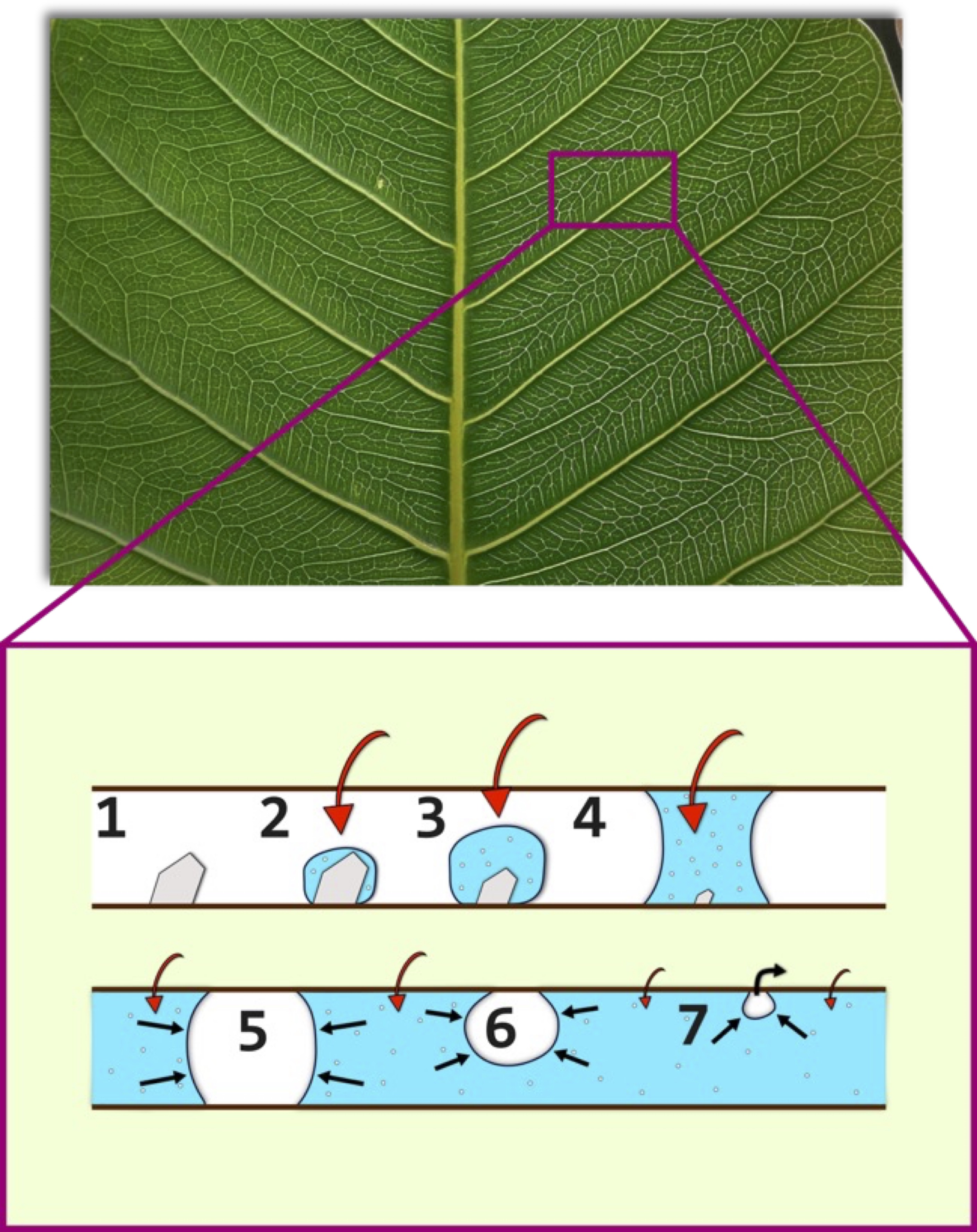
Objectives The main objective of the internship is to understand the physics of the refilling when solutes are present. Our approach will be to manufacture biomimetic leaves made of a thin layer of transparent silicone (PDMS), in which we design a microfluidic chip with channels (Fig. a) where refilling can be quantified by image analysis [4]. The silicone is indeed porous to water vapour, allowing evaporation or condensation. The internship student will study the dynamics of refilling of dried channels initially filled with salt/sugar crystals (Fig. b). We will explore two strategies: (i) put the chip into a humid environment, (ii) design neighbour channels that are full of water (which occurs in plants, where sap circulates in two distinct networks of channels), and can also bring humidity. This internship is mostly experimental, but also involves modelling of the observed refilling dynamics.
Outcomes We aim at demonstrating that the physical role of solutes is essential to the survival of plants, giving cues to solve the mystery of embolism repair.
Published on March 16, 2026 Updated on March 16, 2026
Share the linkCopyCopiedClose the modal windowShare the URL of this pageI recommend:Consultable at this address:La page sera alors accessible depuis votre menu "Mes favoris".Stop videoPlay videoMutePlay audioChat: A question? Chatbot Robo FabricaMatomo traffic statisticsX (formerly Twitter)

 MasterNanosciences, nanotechnologies