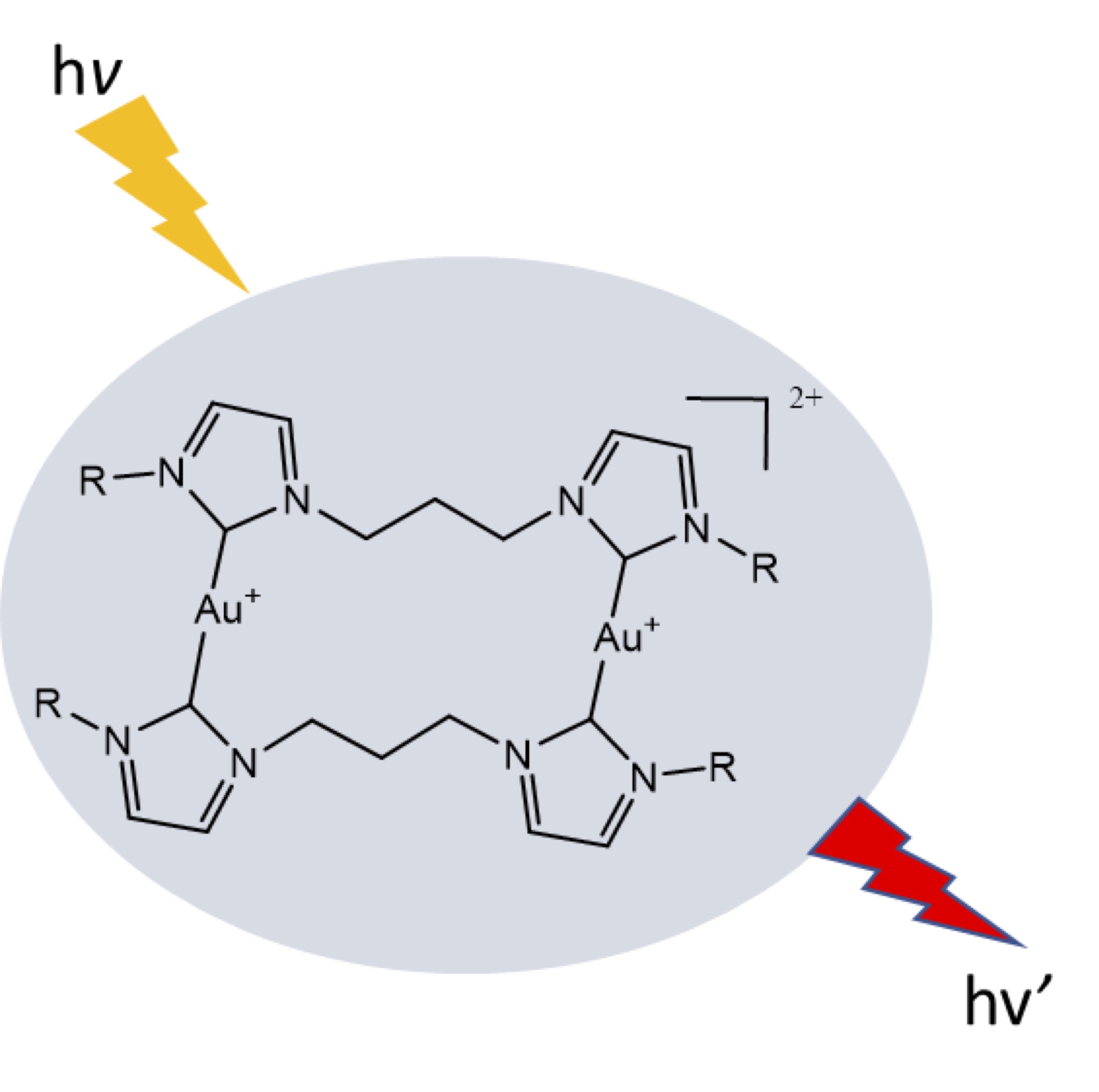
Molecular materials built with Au(I) complexes and carbene N-heterocyclic ligands for redox photochemistry
This project focuses on the synthesis and characterization, using electrochemistry and photophysics, of gold(I) metal complexes with a view to obtaining new molecular materials that are effective for capturing and converting solar energy. Gold(I) complexes with N-heterocyclic carbene (NHC) ligands have attracted growing interest. Long considered photo-inert due to the closed electronic configuration of gold(I), these complexes have recently been reevaluated in the context of redox photochemistry. It has been demonstrated that fine engineering of the ligand, makes it possible to obtain certain Au(I)-NHC complexes with emission properties in the visible and electronic excited states with sufficient lifetime and redox properties suitable for the photoinduced activation of organic substrates. These advances have paved the way for the use of Au(I)-NHC complexes as alternative photosensitizers to conventional transition metal complexes such as [Ru(bpy)3]2+ or [Ir(ppy)3], offering interesting prospects in terms of robustness and structural modularity, thus broadening the field of metal architectures that can be exploited in redox photochemistry.
During the internship, the first step will be to synthesis and study dinuclear carbene N-heterocyclic complexes of the {Au(NHC)2}2 type, and heteroleptic complexes [Au(NHC)(CZ)] (CZ= carbazole). The complexes will be characterized in solution by classical spectroscopies (UV-visible, IR and RMN), electrochemistry and under light excitation, the emission properties will be recorded. Subsequently, based on the results obtained, homo- or bimetallic Au/Ag metallopolymers will be considered using suitable ligands with two opposite NHC coordination sites. The properties of these new molecular materials will be evaluated, in particular the influence of morphology on emission efficiency.
Published on March 16, 2026 Updated on March 16, 2026
Share the linkCopyCopiedClose the modal windowShare the URL of this pageI recommend:Consultable at this address:La page sera alors accessible depuis votre menu "Mes favoris".Stop videoPlay videoMutePlay audioChat: A question? Chatbot Robo FabricaMatomo traffic statisticsX (formerly Twitter)

 MasterNanosciences, nanotechnologies