Mechanical Behavior of cancer cells in collagen matrices by AFM and TFM
Cancer cells are capable of adapting to their environment by modifying their mechanical behavior (Rother et al., Open Biol., 2014). Depending on the mechanical or chemical signals they receive, they reorganize their cytoskeleton, modify their morphology, and express different adhesion receptors (Laurent et al., PLos ONE, 2014); this ability depends on their tumor grade.
Until now, many studies have focused on the mechanical behavior of cells adhering to a 2D substrate, with only a few studies on cells immersed in a 3D matrix, even though this configuration is closer to the in vivo configuration. The primary objective of this internship will be to measure the viscoelastic behavior of cancer cells using atomic force microscopy (AFM JPK instruments Nanowizard IV). The cells will be included in matrices of different concentrations and compositions (collagen, collagen and fibronectin, collagen and RGD peptide, etc.) in order to distinguish between purely mechanical effects and integrin-dependent biochemical effects. Breast cancer cell lines with varying tumor grades will be used to establish a link between the invasive capacity of the cells and their response to different matrices.
For these dynamic AFM measurements, we will use a mode called force modulation: an initial indentation of the cell is performed, and then a low-amplitude sinusoidal oscillation is superimposed on this initial indentation at different frequencies. Measuring the deflection of the lever in response to this oscillation allows us to deduce the complex shear modulus (Abidine et al., Biophys. J., 2018).
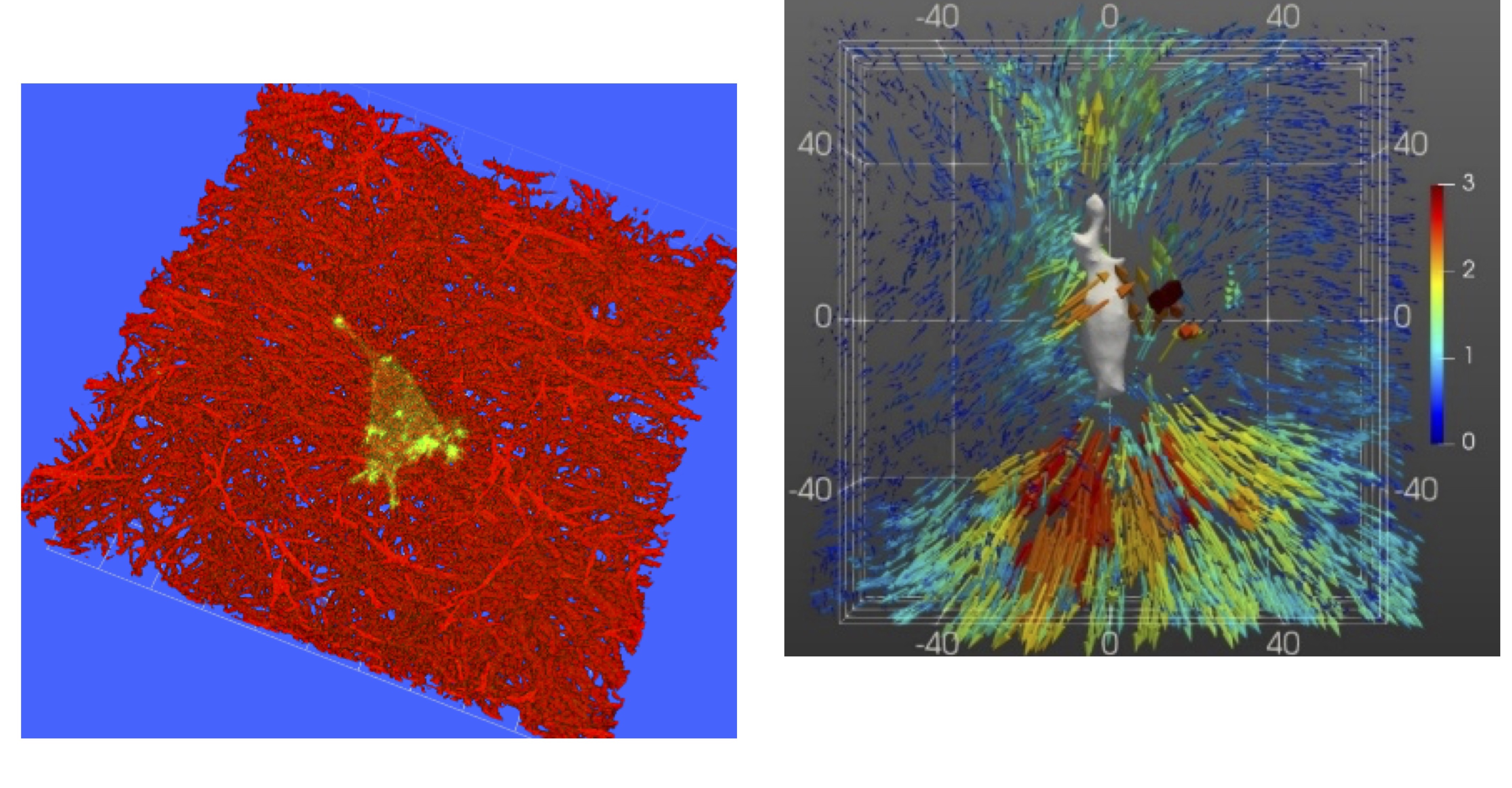
The other objective of this internship will be to measure the traction capacity of these same breast cancer cells in a 3D matrix, i.e., to measure the deformation of the matrix when cancer cells move within it. For these experiments, we will use the confocal microscopy reflectance method (Laforgue et al., Scientific Reports, 2022): after immersing the cells in the matrix, we observe the movement of the fluorescent cells and, simultaneously, the movement of the collagen fibers surrounding these cells. These displacement field measurements will be performed for the different matrices considered (collagen, collagen and fibronectin, collagen and RGD peptide, etc.) and for the different cancer lines.
Published on March 16, 2026
Updated on March 16, 2026

 MasterNanosciences, nanotechnologies