Experimental Investigation of Frictional Rupture Dynamics in Granular Interfaces
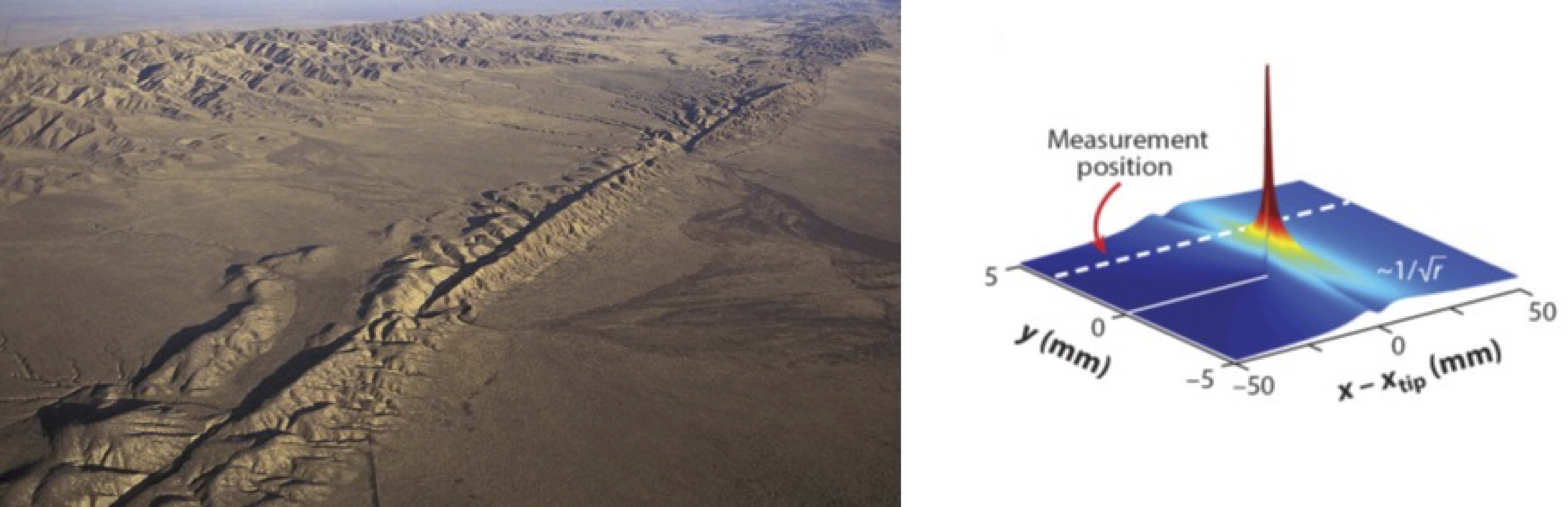
The onset of frictional sliding is mediated by the propagation of localized rupture fronts along an interface. In simple systems composed of two elastic solids in contact, these rupture fronts have been shown to behave as shear cracks and can be described within the framework of Linear Elastic Fracture Mechanics. In this picture, rupture propagation is governed by stress concentration at the tip and by an energy balance between stored elastic energy and dissipation at the interface.
The objective of this Master project is to experimentally investigate how this fracture-like description of friction is modified when the interface contains a thin granular layer. Such a configuration represents a strongly heterogeneous and dissipative medium, where contact rearrangements, force chains, and grain-scale friction may alter the structure of the stress field and the energy budget driving rupture propagation. Understanding how disorder and granular rheology influence rupture dynamics is a fundamental question in the physics of friction.
The project is based on an existing experimental setup in which two elastic plates are pressed together and sheared, with a confined granular layer at their interface. The system exhibits stick–slip dynamics, during which rapid rupture fronts propagate along the interface. The student will perform controlled experiments while varying key physical parameters such as normal load, granular layer thickness, grain size, and material properties.
Dynamic strain fields in the elastic plates will be measured using strain gauges, allowing direct characterization of the stress fields driving rupture propagation. Simultaneously, high-speed imaging and particle tracking will provide access to grain-scale kinematics within the granular layer. These combined measurements will make it possible to (i) test the validity of fracture mechanics concepts in a disordered interface, (ii) determine rupture velocities and energy dissipation, and (iii) analyze how granular rheology modifies the dynamics of frictional failure.
The experimental data will be analyzed using theoretical frameworks from fracture mechanics and granular physics. The precise research direction can be refined during the first semester, depending on the student’s background and interests. This project is intended for a student finishing a Bachelor’s degree in Physics with a strong interest in mechanics, condensed matter physics, or complex systems. Beyond its fundamental interest in friction and fracture, the study may also provide insight into rupture processes occurring along natural seismic faults.
Published on March 16, 2026 Updated on March 16, 2026
Share the linkCopyCopiedClose the modal windowShare the URL of this pageI recommend:Consultable at this address:La page sera alors accessible depuis votre menu "Mes favoris".Stop videoPlay videoMutePlay audioChat: A question? Chatbot Robo FabricaMatomo traffic statisticsX (formerly Twitter)

 MasterNanosciences, nanotechnologies