Rheological characterization of Cellulose Nano Crystal gels
Cellulose nanocrystals (CNC) are captivating nanoparticles extracted from plant biomass. These naturally biosourced nanocrystals are akin to slender rod-like biopolymers, about 10 nm in diameter and 100 nm in length, with tunable surface chemistry. When dispersed in a fluid such as water, they can self-assemble into micro- and mesostructures that percolate to form a rigid network called a hydrogel, with nanoscale pores that restrain water. These environmentally friendly soft materials have numerous potential applications in the fields of civil engineering, health, food, electronics, and robotics. In addition, CNC hydrogels are parent materials for producing other interesting biosourced nanomaterials, such as nanopapers with notable barrier and optical properties, nanocomposites, as well as architected materials such as ice-templated or 3D-printed cellular structures with relevant specific mechanical properties for structural applications.
To be properly used in these applications, significant effort is required to better understand the complex rheology of CNC hydrogels.
To address this challenge, a PhD project is in progress, mainly focused on coarse-grained simulations to provide quantitative statistical insights into the elementary nanofiber-scale mechanisms governing CNC network formation and their rheological properties.
The aim of this internship will be to take part in the development of the experimental component of this thesis. The intern will investigate the mechanical response of CNC hydrogels by tuning (i) their volume fraction and (ii) their interactions by screening electrostatic repulsion through the addition of a well-controlled salt concentration, thereby varying the balance between attraction and repulsion. Two modes of deformation will be explored at different scale : shear and compression.
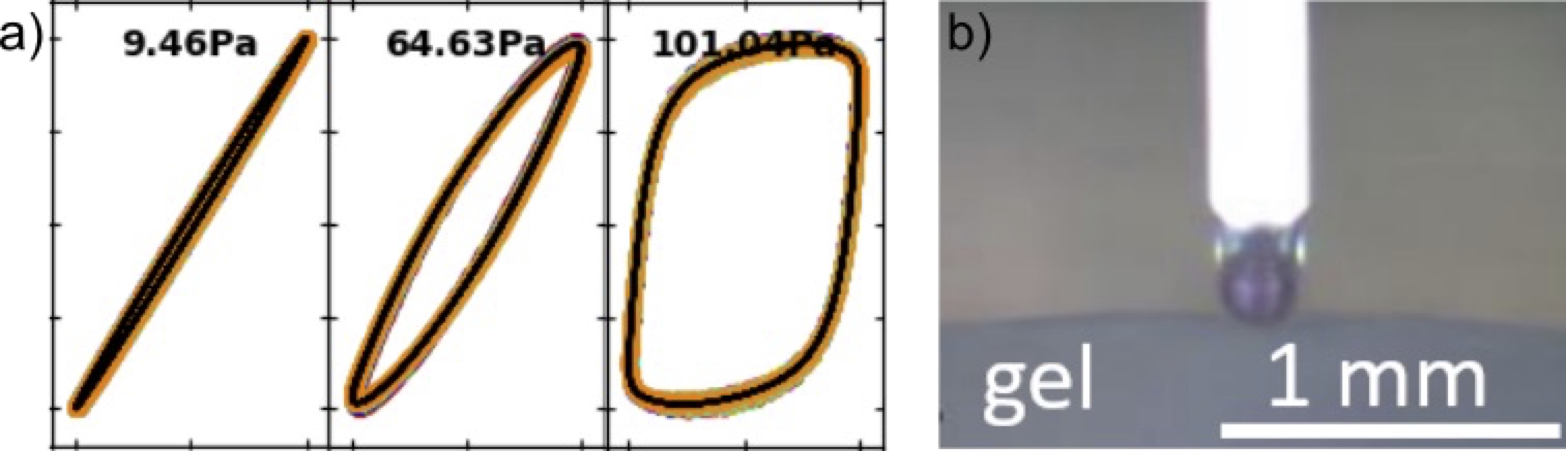
At the macroscopic scale, rheological measurements such as Large Amplitude Oscillatory Strain or Stress (LAOS) and creep tests will be performed using a rheometer or a uniaxial testing machine.
At smaller scales, the hydrogels will be subjected to quasistatic and oscillatory compression indentation tests using the highly sensitive FemtoTools device located at the Mecagreen platform in the 3SR Lab (hall PEI).
The intern will have the opportunity to work in interaction with the PhD student (S. Virak) and the supervising team (M. Bouzid, A. Naillon, and L. Orgeas). The experimental developments and results will be discussed in light of the computations developed in the PhD. Depending on the progress of the work and its interest to computation, the intern may also use coarse-grained simulations to develop numerical skills
Published on March 16, 2026 Updated on March 16, 2026
Share the linkCopyCopiedClose the modal windowShare the URL of this pageI recommend:Consultable at this address:La page sera alors accessible depuis votre menu "Mes favoris".Stop videoPlay videoMutePlay audioChat: A question? Chatbot Robo FabricaMatomo traffic statisticsX (formerly Twitter)

 MasterNanosciences, nanotechnologies