Emergence of spatial rhythms in Escherichia coli biofilms
Oscillations are a hallmark of nonlinear dynamical systems. In living systems, rhythmic behaviors may emerge not only from dedicated genetic clocks but also from collective interactions in spatially extended populations. In several bacterial species, cell division at the surface of solid media produces biofilm-like colonies exhibiting concentric ring patterns suggestive of self-organized spatiotemporal dynamics. Whether such phenomena exist in Escherichia coli — arguably the best-characterized bacterial model organism — remains largely unexplored.
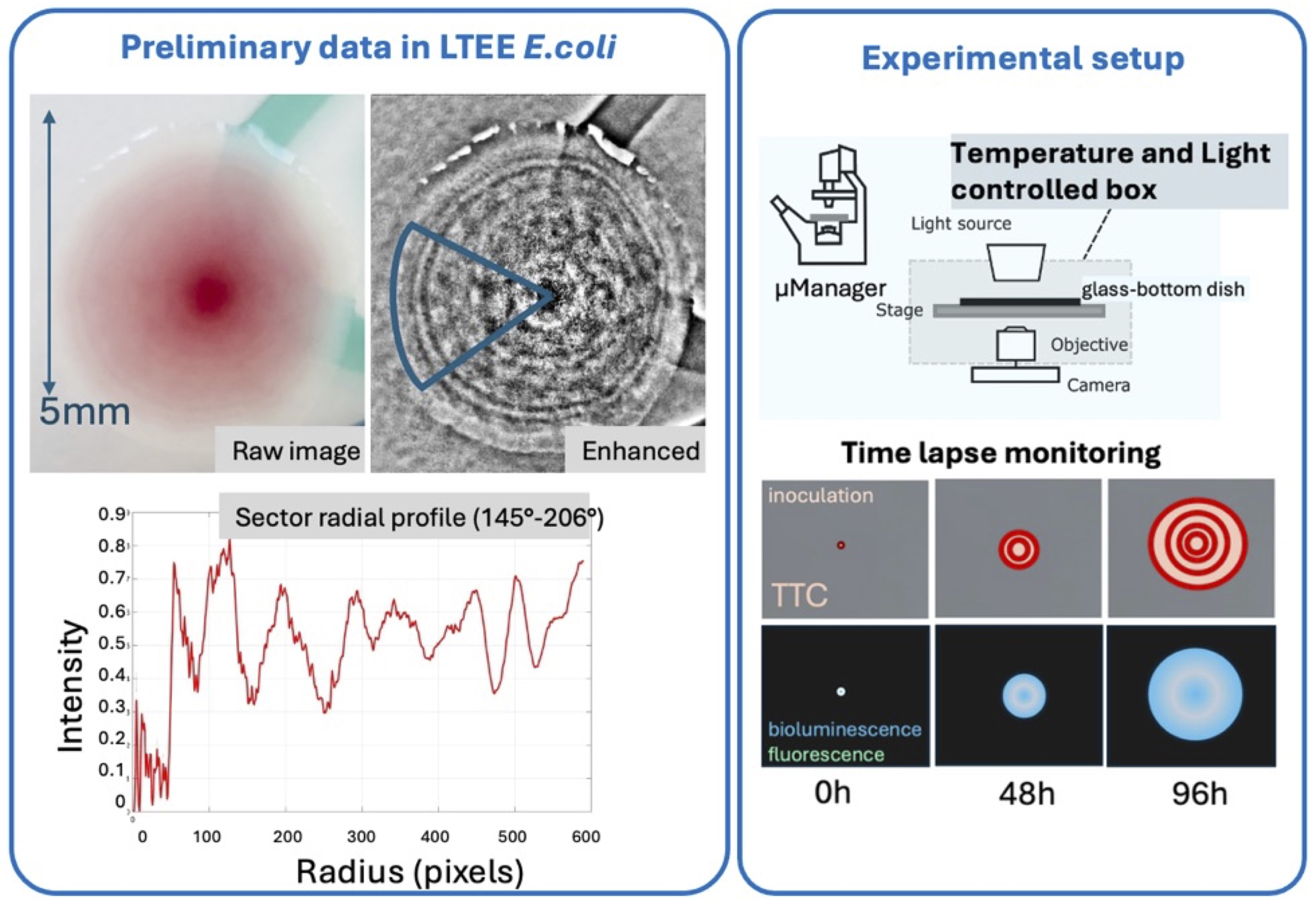
This project approaches E. coli colony growth as a problem of pattern formation in a growing active medium. We will compare ancestral strains with strains derived from the Long-Term Evolution Experiment (LTEE), which have evolved for more than 80,000 generations under daily ~24-hour growth cycles. Preliminary observations suggest that evolved strains display enhanced and more structured ring patterns during biofilm development, raising the question of whether long-term selection in periodic environments can amplify intrinsic dynamical behaviors.
We will first establish controlled time-lapse imaging of colony growth under imposed oscillatory conditions (light–dark and temperature cycles). Quantitative image analysis will be developed to extract radial growth laws, front propagation dynamics. In a second phase, we will test whether the observed structures can be captured by minimal models inspired by reaction–diffusion systems, metabolic feedback, or coupled oscillators in expanding media. In parallel, and in close collaboration with biologists, we will investigate candidate molecular reporters and genetic differences between ancestral and evolved strains to identify the biological mechanisms underlying the dynamics.
The student will be embedded in an interdisciplinary research axis currently being developed between LIPhy (physics of complex systems) and TIMC/TrEE (evolutionary microbiology): LIPhy: Irina Mihalcescu (circadian rhythms, time-lapse microscopy and image analysis; internship advisor) and Karin John (active matter and bacterial biofilm modeling). TIMC: Thomas Hindré (experimental evolution and gene network rewiring), Joël Gaffé (evolutionary genomics), and Corinne Mercier (bacterial physiology).
This project is designed as a potential entry point toward an M2 internship and a PhD project at the interface between physics and evolutionary microbiology.
Published on March 16, 2026 Updated on March 16, 2026
Share the linkCopyCopiedClose the modal windowShare the URL of this pageI recommend:Consultable at this address:La page sera alors accessible depuis votre menu "Mes favoris".Stop videoPlay videoMutePlay audioChat: A question? Chatbot Robo FabricaMatomo traffic statisticsX (formerly Twitter)

 MasterNanosciences, nanotechnologies