Design of a radiopaque hydrogel hybrid neural probe and evaluation of its behavior in brain-mimicking phantoms using X-ray computed tomography
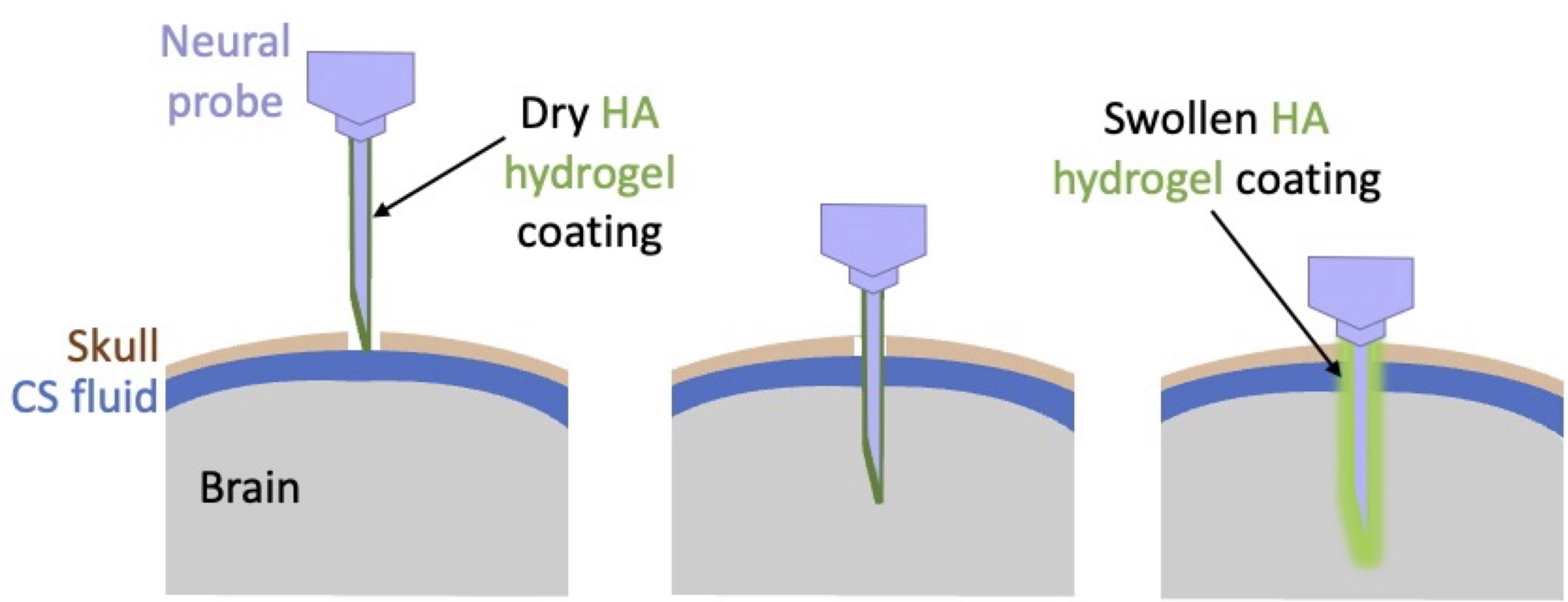
Penetrating neural probes have demonstrated great potential in human brain-machine interface applications. However, the success of this technology is limited by challenges in maintaining a stable, long-term interface for reliable recording and stimulation, due to an inflammatory response called foreign body reaction. To reduce this reaction, research has focused on the use of flexible probes, that better match the mechanical properties of surrounding neural tissue, thereby reducing device rejection. The fabrication of these compliant devices typically involves either the use of soft polymeric materials as substrates, such as parylene, polyimide, polydimethylsiloxane, and/or the use of significantly thinner stiff materials. However, increasing flexibility renders the devices more fragile and thus complicates the insertion procedure. The implantation of soft electrodes can be facilitated by coating the electrode with a stiff, water-soluble polymer that dissolves once in the brain, by using electrode shuttles, or other auxiliary tools. Another approach involves building the electrodes on a mechanically adaptive substrate that can undergo a stiff-to-soft transition when placed in physiological conditions. In this context, we recently developed a strategy based on a hyaluronic acid (HA) hydrogel coating applied to the probe surface (Figure 1). The role of the HA hydrogel coating is to act (i) as a stiffening material in the dry state for insertion of the probe in the brain and, (ii) as a soft biomimetic coating after re-swelling following implantation allowing to minimize inflammatory host tissue response. As hyaluronic acid is a major constituent of brain extracellular matrix, this soft coating represents a promising approach to enhance implant integration. However, hydrogels applied as coating layers are expected to be particularly prone to mechanical stresses and deformations during the re-swelling process following implantation due to the significant mechanical constraints arising from their immobilization on the devices’ surface. This internship project thus aims to investigate the behavior of the HA hydrogel hybrid probe after its insertion into an agarose-based phantom mimicking brain tissue, using X-ray computed tomography (CT) imaging. To this end, the first step will consist in labeling the hydrogel with an iodine contrast agent to achieve sufficient X-ray signal without significantly affecting the physico-chemical properties of the HA network. This will involve chemical modification of polymers, followed by the synthesis and characterization of the hydrogels in both bulk form and as thin coating films, with regard to their mechanical behavior and swelling properties. The second step will focus on real time visualization of radiopaque hydrogel coating re-swelling using X-ray CT. This will require detailed image analysis to correlate the re-swelling kinetics and probe shape as a function of its preparation conditions.
Published on March 16, 2026 Updated on March 16, 2026
Share the linkCopyCopiedClose the modal windowShare the URL of this pageI recommend:Consultable at this address:La page sera alors accessible depuis votre menu "Mes favoris".Stop videoPlay videoMutePlay audioChat: A question? Chatbot Robo FabricaMatomo traffic statisticsX (formerly Twitter)

 MasterNanosciences, nanotechnologies